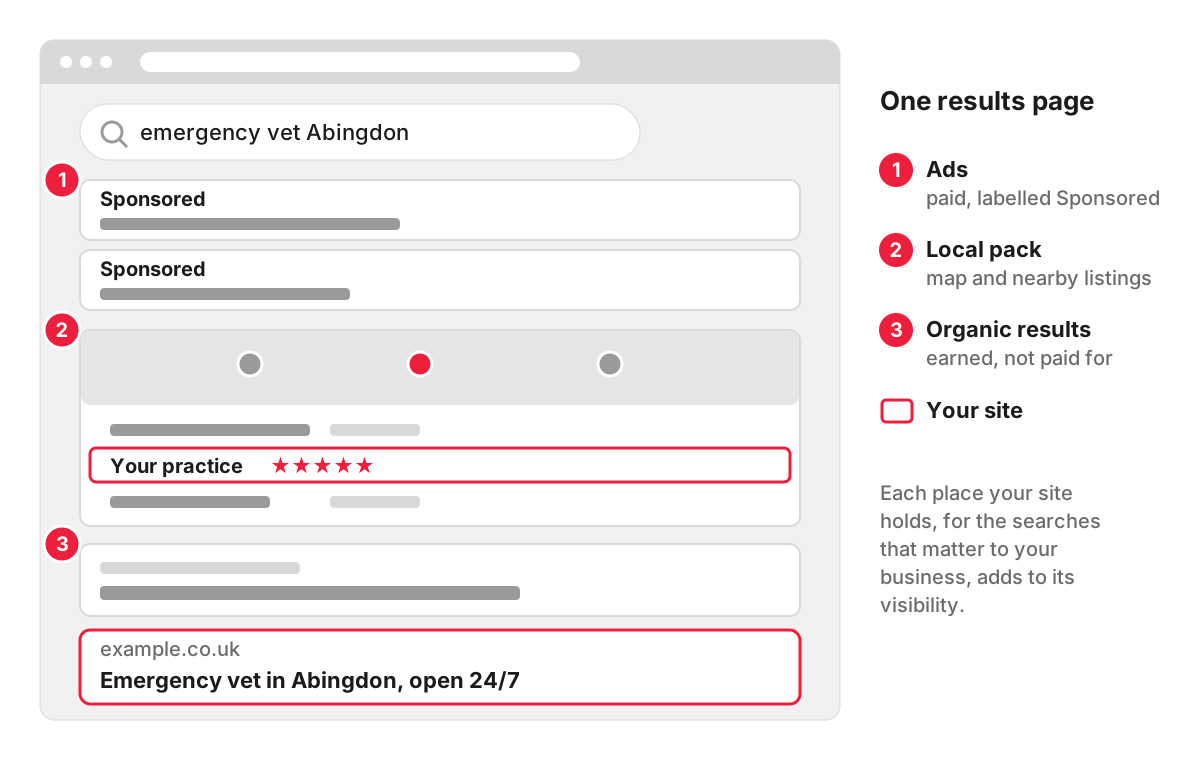
Website visibility is how often and how prominently a site appears in search results for the searches that matter to its business. It is measured through impressions (how many times your pages were shown) and positions (where they appeared). A site can be highly visible and still get few visits if it shows up for the wrong searches or too far down the page.
Two ways to measure it
Google Search Console is the free tool where Google reports on your own site. Its Performance report shows impressions, clicks, click-through rate and average position, broken down by search query, page, country and device, for up to the last 16 months. This is real data, with limits worth knowing: it covers Google only, some rare queries are hidden to protect user privacy, and the average position is averaged across all the searches where the site appeared, so a page that appears at position 3 on some searches and 40 on others can report something in between.
A visibility index in an SEO tool, such as the Sistrix Visibility Index or the Visibility metric in Semrush Position Tracking, is an estimate. The tool checks rankings for a set of keywords and weights each position by the traffic or clicks it would be expected to bring. The advantage is comparison: you can put your site next to a competitor’s on the same scale, which Search Console cannot do. The drawback is that the score depends on which keywords the tool tracks, so two tools can show different trends for the same site.
Both are useful, as long as each is read on its own terms. A rise in Search Console impressions and a rise in a tool’s index are two different measurements and should not be compared directly.
Visibility, traffic and enquiries are three different numbers
Visibility is the first link in a chain. Impressions turn into clicks when the title and description in the search result answer what the person was looking for. Clicks turn into enquiries when the page delivers on that promise.
Take a veterinary practice in Abingdon that publishes an article on how often to worm a dog. The article starts ranking for searches across the UK, and Search Console impressions double. Very few of those readers will register a pet in Abingdon, so visibility grew and appointments did not. Meanwhile a modest rise in positions for “emergency vet Abingdon” may bring in more clients than the whole article.
When you look at visibility, look at it for the searches that lead to business: your services, your products, your area.
What affects visibility, and how to improve it
- Indexing. A page that Google has not added to its index cannot appear at all. The Page indexing report in Search Console lists pages that are excluded and the reason for each. Search engine indexing explains the common causes.
- Relevance to the search. Each service, product range or location people search for needs a page that answers that search. One page trying to cover five services usually ranks well for none of them. Keyword research shows which searches deserve a page of their own.
- Titles and descriptions. Pages with many impressions and few clicks often need a clearer title and description in the search result. Structured data can add details such as product prices, review ratings or event dates to the listing; see microdata markup.
- Site structure and internal links. Pages linked from the menu and through internal links from related pages are found and understood faster than pages buried several clicks deep.
- Technical health. Slow mobile pages, broken links, duplicate pages and blocked sections hold the whole site back.
- Authority. Links from relevant, trustworthy websites show search engines that others vouch for your content. Google describes link analysis, including PageRank, as one of its core ranking systems.
- Local results. The map listings for searches like “plumber near me” draw on your Google Business Profile, which reports its own views, calls and website clicks separately from Search Console.
Competitors are working on all of these too, so visibility can fall without any change on your side.
Checking your own site
- Open Search Console, go to Performance, then Search results, and set the date range to the last 16 months to see the trend.
- Use the comparison option to set this quarter against the same quarter last year, so seasonal swings do not mislead you.
- Filter the queries for your main service or your town, and note which pages appear for them and at what average position.
- In the Pages tab of the same report, look for pages with many impressions and very few clicks.
- Open Indexing, then Pages, and see whether any important pages are missing from the index.
Searching for your own business in Google gives a distorted picture, because results change with your location, device and search history.
Tracking visibility on our SEO projects
When we provide SEO services, we use Ahrefs and Semrush together with your Google Search Console data, so the tool estimates and competitor comparisons are always checked against what Google itself reports for your site. Progress is judged on the searches that bring enquiries, with impressions and positions read alongside clicks and conversions.
FAQ
How long does it take to improve website visibility?
On our SEO projects, first movement usually shows in 2-3 months, steady growth follows in months 4-6, and the strongest results come between 6 and 18 months. Fixing a technical problem, such as an important page blocked from indexing, can show up sooner, once Google recrawls the page.
Why has my website visibility dropped?
Google’s guide to debugging drops in Search traffic names the usual causes: algorithm updates, technical problems that stop pages being crawled or indexed, security or spam issues, seasonal changes in demand, and changed URLs after a website migration. Check the Google Search Status Dashboard for announced ranking updates on the dates of the drop, then find which pages and queries lost the most impressions.
Do AI Overviews count towards website visibility?
In Search Console they do. Google says that appearances in AI features such as AI Overviews and AI Mode are included in the overall search traffic in Search Console, under the Web search type, together with ordinary results.
Does advertising on Google improve organic visibility?
No. Google states that it does not accept payment to crawl a site more often or to rank it higher. Ads appear in their own labelled places on the results page. They can bring visitors while organic rankings grow, which is the role of PPC.