
PPC (pay-per-click) is a form of online advertising in which the advertiser pays each time someone clicks an ad; an ad that is shown but not clicked costs nothing. The best-known example is Google Ads, where a business chooses the searches it wants to appear for, sets how much it will pay for a click and is charged when a searcher visits its site.
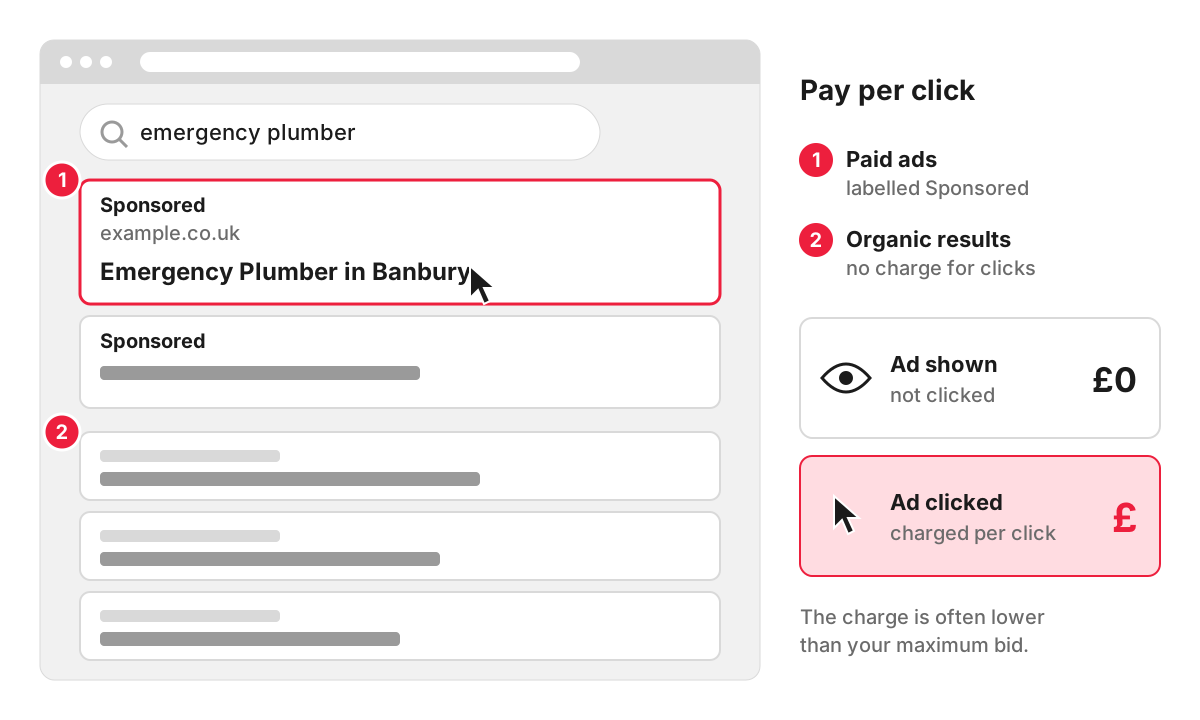
What happens between a search and a click
Imagine a homeowner in Banbury typing “emergency plumber” into Google at eight in the evening. Several local plumbing firms have told Google they want to appear for searches like this one, so Google runs an auction among them in the fraction of a second before the results page loads.
Position on the page is not decided by money alone. Google’s own help pages describe the auction as a calculation of Ad Rank, whose inputs include:
- the bid – the most the advertiser is prepared to pay for a click;
- ad quality – how likely the ad is to be clicked, how closely it matches the search, and how useful the page behind it is;
- context – the searcher’s location, device, time of day and the other ads competing at that moment;
- ad assets – extra links, a phone number or an address that make the ad more useful.
This is why a smaller firm with a relevant ad and a clear landing page can appear above a competitor with a higher bid. Google also notes that the amount actually charged for a click is often lower than the maximum bid, because you pay only what is needed to beat the Ad Rank of the advertiser below you. The Quality Score shown in the account, a rating from 1 to 10, is a summary of the same quality signals and helps spot weak keywords.
Many accounts now use automated bidding, where Google sets the bid for each auction towards a goal you give it, such as a target number of enquiries or a target price per enquiry. That only works well when the account records which clicks led to a call, a form or a sale.
Where pay-per-click ads appear
- Google. Search results, Google Shopping for products, and, with other campaign types, YouTube and partner websites. Some of these formats are charged per impression or, for YouTube video ads, per view.
- Microsoft Advertising. Ads on Bing and on partner search sites such as Yahoo, AOL and DuckDuckGo. Campaigns can be imported from Google Ads, which makes it a common second channel.
- Meta (Facebook and Instagram). Meta can charge per link click when a campaign is optimised for link clicks, but for most other goals it charges per impression, so most Meta advertising is not PPC in the strict sense.
- Other platforms. LinkedIn can charge per click on campaigns that send people to a website, and Amazon’s Sponsored Products are cost-per-click ads.
Where the money goes: ad spend and the specialist’s fee
A PPC budget is two separate payments.
Ad spend goes to the platform. It is the money that pays for clicks, charged by Google or Microsoft directly to the card or invoice account attached to the ad account.
The fee goes to whoever plans and runs the campaigns: a freelancer, an agency or an in-house specialist. It pays for keyword research, writing ads, setting up conversion tracking, and the weekly work on search terms, negative keywords and bids.
Before signing with anyone, ask whose name the ad account is in, who pays the platform, and if you will have your own login to the account. If a provider pays the platform and re-bills you, you cannot see what was actually spent on clicks, and if the account is in their name you may lose its history when you leave.
With our Google Ads management, ad spend is separate from our fee and paid directly to the platform, and you keep full ownership of the account. We are a Google Partner agency with certified Google Ads specialists.
PPC or SEO first?
PPC brings visitors as soon as the ads are approved and stops the day you stop paying. SEO takes months to build, and the traffic it earns does not disappear when a monthly payment ends.
For many small businesses the sensible order is both, with different jobs. PPC produces enquiries now and shows which searches turn into customers, because every click, keyword and conversion is recorded. Those findings tell you which service pages are worth the longer SEO effort. Once organic rankings bring in steady enquiries for a search, the ad budget for it can be reduced or moved elsewhere.
Starting with SEO alone makes more sense when the searches you need are within reach in organic results but expensive to bid on, or when the business has time to wait and no budget for clicks. Whichever comes first, the page visitors land on decides how many of them get in touch, which is the job of conversion rate optimisation.
When PPC is worth it for a small business
PPC tends to pay off when:
- people already search for what you sell with clear intent, such as “boiler repair Banbury” or “emergency dentist Oxford”;
- one job or order is worth enough to cover the clicks that do not turn into customers;
- someone can answer the phone and reply to enquiries quickly while the ads are running;
- the site has a page that answers the search and a form or phone number that is tracked.
It is a harder fit when hardly anyone searches for your product yet, when each sale is small with thin margins, or when calls and forms are not tracked, because then nobody can tell which clicks paid for themselves. A plumbing firm can keep spending in check by showing ads only within its service area and only during the hours it can take calls; both settings are standard in Google Ads and Microsoft Advertising.
FAQ
What does PPC mean in the UK?
In UK marketing PPC means the same as anywhere else: pay-per-click advertising, mostly through Google Ads and Microsoft Advertising. The UK-specific part is regulation. The Advertising Standards Authority states that paid-for or sponsored listings on search engines are covered by the CAP Code, so a claim in a search ad, such as “cheapest in Oxford”, needs the same evidence as it would in print.
What is the difference between PPC and CPC?
PPC is the way of paying: you are charged for clicks. CPC, cost-per-click, is the price of a single click. Google Ads separates the maximum CPC you set from the actual CPC you are charged, and the average CPC in reports is the total spend divided by the number of clicks.
How is a PPC budget controlled?
In Google Ads you set an average daily budget for each campaign. On a busy day Google can spend up to twice that amount, but over a month it charges no more than 30.4 times the daily budget. Before launch, Keyword Planner gives an estimate of how often your keywords are searched and what ads on them tend to cost.
How soon can PPC ads start showing?
New ads go through Google’s review first, and most are reviewed within one business day. On our Google Ads projects, the first useful data usually comes in 2-4 weeks, and stable results follow in 2-3 months.