Conversion rate optimisation (CRO) is the process of increasing the share of website visitors who take the action you want, such as sending an enquiry, booking an appointment or buying a product. It works with the traffic you already have: you find where people hesitate or leave, change that part of the site and measure whether more of them go on to act.
How conversion rate is calculated
The conversion rate is the number of conversions divided by the number of visitors, multiplied by 100.
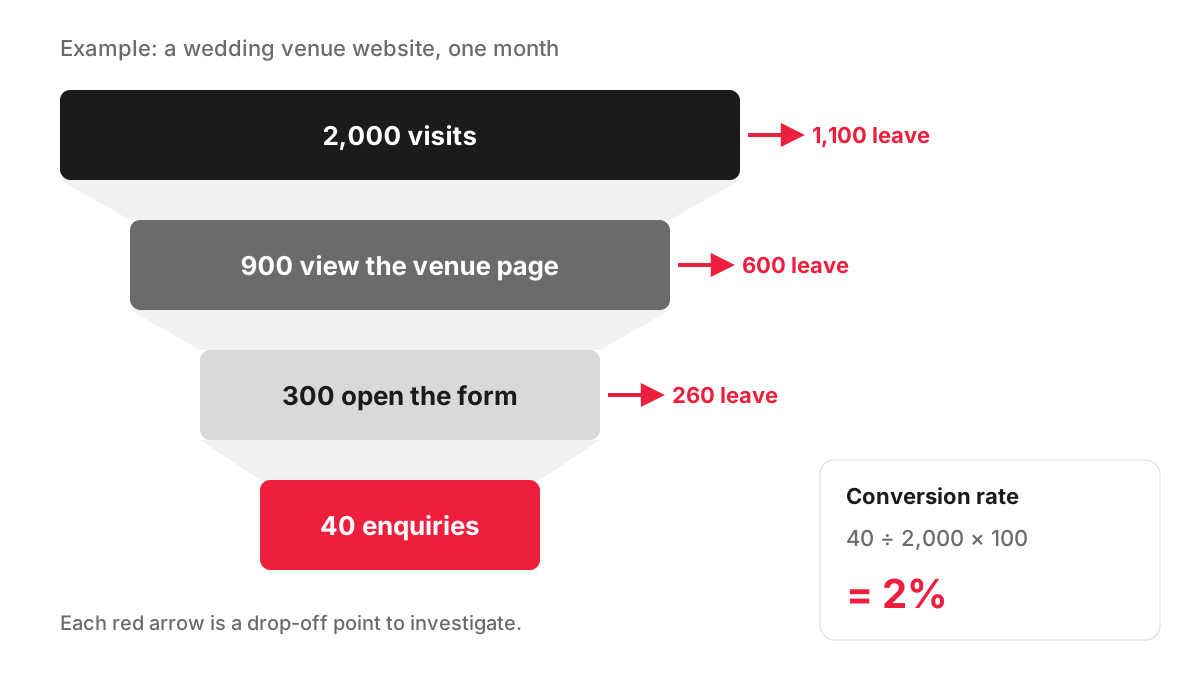
Take a wedding venue in the Cotswolds whose website had 2,000 visits last month and received 40 enquiries through its form. Its conversion rate for enquiries is 40 ÷ 2,000 × 100 = 2%. If a change to the enquiry page brings that to 50 enquiries from the same 2,000 visits, the rate becomes 2.5%, and the venue has ten more couples to talk to without spending more on traffic.
Two decisions make the figure meaningful:
- What counts as a conversion. A sent form, a click on the phone number, a completed purchase and a newsletter sign-up are different actions. Measure each one separately, and keep the main goal apart from the small steps that lead to it, such as adding a product to the basket.
- What you divide by. Google Analytics 4 calls these important actions “key events” and can report two rates: session key event rate (per visit) and user key event rate (per person). Someone who visits three times before booking counts once in the second and three times in the first, so the two rarely match.
A single rate for the whole site mixes people reading a blog post with people on the checkout page. The figures that guide decisions are the ones for a specific page, device or traffic source.
What counts as a good conversion rate
There is no figure that holds across businesses. An emergency locksmith whose visitors need a door opened today and an online shop selling £1,500 handmade bookcases will see very different rates, and both can be doing well. Published averages tend to blend sectors, countries and definitions of a conversion, so they say little about your site.
So is 2.5% a good conversion rate? For the wedding venue above it was, because it meant ten more enquiries from the same traffic. For a shop that converted 4% of its visitors last year, the same figure would be a warning sign. The comparison that helps is your own rate over time, by page and by traffic source. Read it alongside the number of enquiries or sales: if an advertising campaign stops sending irrelevant visitors, the rate goes up while the number of enquiries stays the same, and nothing has really improved.
The difference between SEO and CRO
SEO brings people to the site from search results. CRO works on what they do once they arrive. One fills the top of the funnel, the other decides how much of that traffic turns into business.
On a small business site the two share the same pages, so they have to be planned together. A service page needs enough text to rank and answer questions, and it also needs the price guide, the phone number and the form within easy reach. What a visitor sees before scrolling, the content above the fold, carries most of that second job.
What the process looks like
- Research. Analytics shows where people leave and on which devices. Session recordings and heatmaps show what they click, how far they scroll and where they get stuck. Going through the site on a phone as a customer would, and reading the questions people ask by email or phone, fills in the rest.
- Hypothesis. Each finding becomes a testable statement. For example: “On mobile, the booking button only appears after three screens of text. Moving it into the first screen will increase booking requests from mobile visitors.”
- Change. The page is updated, and the date of the change is recorded so it can be matched against the data later.
- Measurement. The result is compared over a comparable period and the same traffic sources, or with a split test where the traffic allows it.
An online wine merchant might find that many shoppers leave at the step where they are asked to create an account before paying. Offering a guest checkout is a small change that can be checked within a few weeks.
Where to start on your own site
- Make sure every form, phone click and purchase is tracked. Without that, no change can be measured.
- Begin with the pages closest to a sale or enquiry: service pages, product pages, the basket and the contact page.
- Remove obvious friction first: a form that fails on some phones, a phone number that cannot be tapped, prices that are hard to find, slow mobile pages.
- If your site has few visitors, a split test may never reach a reliable result; A/B testing covers what to do in that case.
Where CRO work with us begins
CRO work with us usually starts with a UX audit. Where Microsoft Clarity or Hotjar is connected to your site, we go through session recordings and heatmaps; where neither is installed, our team tests the site itself. You receive screenshots of each problem with a recommendation on how to fix it, so the changes can be prioritised and planned. A UX audit starts from £530.
FAQ
What is the difference between CRO and UX?
User experience (UX) covers how easy and pleasant a site is to use as a whole. CRO takes the parts of that experience that stand between a visitor and a business goal, changes them and measures the effect on enquiries or sales. Much of CRO work is UX work with a number attached to it.
What is a conversion funnel?
A funnel is the sequence of steps a visitor goes through before converting, for example ad click, landing page, enquiry form, thank-you page. Counting how many people reach each step shows where most of them drop out, which is usually the best place to start. In Google Analytics 4 this view is called a funnel exploration.
Which tools are used for CRO?
Most work starts with an analytics tool for the numbers and a behaviour tool for the reasons behind them. Microsoft Clarity, which is free, and Hotjar record visits and build heatmaps. Split tests need a separate testing tool; Google’s own, Google Optimize, closed on 30 September 2023, so testing now runs through third-party platforms.
How long does CRO take to show results?
A fix for something broken, such as a form that fails on some phones, can show in the enquiry numbers within days. A change to how a page persuades needs enough conversions on both sides of the change to compare, so on a quiet page it can take months. CRO also has no finish line: each round of changes shows where the next round should start.