A landing page is a web page built around a single action, such as requesting a quote, booking a call or buying a product. Visitors usually arrive on it after clicking an ad, an email or a social media post, and everything on the page supports that one action, with few or no links leading elsewhere.
You may also see the term in Google Analytics, where it has a broader meaning: its landing page report counts the first page viewed in each session, including your home page or a blog post. On this page we mean the marketing sense.
How a landing page differs from a home page or a website
A home page is the front door for everyone: new customers, existing clients, job applicants, suppliers. It links to every part of the site because it has to serve all of them.
A landing page serves one audience with one offer. The main navigation is often trimmed or removed, so the visitor’s choice is simple: take the action or leave.
A website is the whole collection of pages. A landing page can sit inside it, at an address such as yoursite.co.uk/kitchen-survey, or stand alone on its own domain for a campaign or event.
Here is the difference in practice. A cookery school runs a Facebook ad for its summer bread-making courses. If the ad links to the home page, people have to find the course themselves, and some will not bother. If it links to a landing page, they see the course from the ad, the price, the dates and a button to book.
The main types of landing page
- Lead generation pages collect contact details through a form or a call. They suit services where the sale happens later: a conveyancing quote, a free home survey, a consultation.
- Click-through pages explain an offer and then pass the visitor on to the next step, such as a shop’s checkout or an online booking system. They are common for product launches and seasonal offers.
- Sales pages are longer and aim to sell directly on the page, for example places on a course or tickets to an event. They carry more detail because the visitor has to decide to pay there and then.
Event registration and app download pages follow the same logic with a different action.
What a good landing page includes
Most landing pages are built from five parts, usually in this order: a headline, a value proposition, a call to action, a lead generation form and social proof.
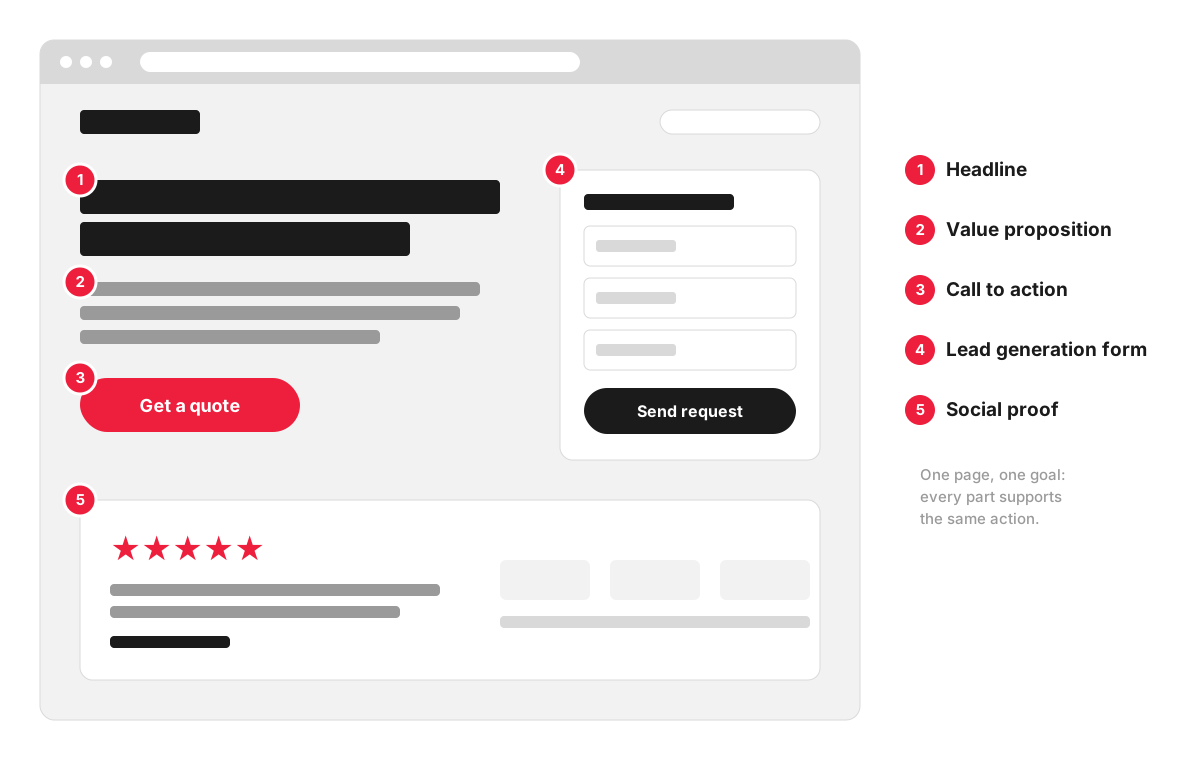
- Headline. It should match the ad. If someone clicked “Same-day windscreen replacement in Swindon”, the page should say the same thing in its first line. A mismatch makes people doubt they are in the right place.
- Value proposition. A line or two on what the visitor gets and who it is for, backed by specifics: what is included, a price or what the price depends on, timescales, the area you cover. With the headline and the main button, it should fit on the first screen; more on that in above the fold.
- Call to action. One main button whose wording says what happens next, such as “Book a survey”, repeated further down a longer page.
- Lead generation form. Ask only for what you need to respond. Each extra field gives people another reason to stop.
- Social proof. Reviews with their source, photos of real work, accreditations, client logos you have permission to use.
Around those five parts, a page that works also needs:
- Answers to the usual doubts. A short FAQ covering the questions your team hears on the phone.
- Fast loading on a phone and on a patchy mobile connection, as well as on office Wi-Fi.
- Tracking. Form submissions, calls and key button clicks recorded as events in your analytics, so you can see which ad, keyword or email produced each enquiry. Without this, you are paying for traffic you cannot judge.
- A confirmation that says what happens next, such as “We will call you within one working day”, if that is true.
An example of a landing page, section by section
Imagine a family-run kitchen fitting firm in Cheltenham running Google Ads for “kitchen fitters near me”. Its landing page could run like this:
- Headline and button. “Kitchen design and fitting in Cheltenham”, a line about the free home survey, a “Book a survey” button and a tap-to-call number.
- Recent work. Photos of fitted kitchens, each captioned with the area.
- How it works. Survey, design, written quote, fitting, in four short steps.
- Reviews. A few recent Google reviews, with a link to the full profile.
- Prices. A typical range and what moves a kitchen up or down it.
- FAQ. How long fitting takes, who removes the old kitchen, what the guarantee covers.
- The form again. Name, phone, postcode and a preferred day for the survey.
When a landing page is worth it, and when a service page will do
A separate landing page usually earns its cost when:
- you pay for every click, as with PPC advertising, and want the page to do one job well;
- you run a specific offer, season or event that does not fit your regular pages;
- the audience is different from your main site’s, such as trade buyers on a consumer site;
- you want to compare messages, which is what A/B testing is for;
- you do not have a website yet and need one offer live quickly.
A good service page is often enough when:
- the traffic comes from organic search, where a full service page that answers more questions and sits within your site’s internal linking tends to perform better;
- your ads promote a service whose page already has a clear first screen, a short form and tracking in place;
- the ad budget is small, and building and maintaining separate pages would cost more than it returns.
Sometimes the most useful first step is improving the service page your ads already point to.
What our landing page price covers
Our landing page design starts from £450 for Basic Landing Page Design; design and development starts from £1,750. That covers a layout built around the conversion, form and event tracking, and quick iterations. Ad campaigns and copywriting are separate pieces of work. We confirm the final price after a short Discovery stage, with a line-item estimate.
FAQ
How do you create a landing page?
Start with the one action you want and the ad, email or post that will send people to the page. Write the headline and offer to match that source, build the page in your CMS or a landing page builder, connect the form and event tracking, and test it on a phone before any traffic arrives. The step-by-step version is in our guide on how to create a landing page.
Can one landing page work for several ads?
Yes, if the ads make the same promise to the same audience. When ads differ in offer, service or location, each one needs its own page or its own version of the page, because the headline has to match what the person clicked.
How do you know if a landing page is working?
Look at its conversion rate: enquiries, bookings or sales divided by visits, broken down by traffic source. Set against the cost per click, that tells you what each enquiry costs. If the rate is low, recordings of real visits usually show where people stop, and improving it is the work of conversion rate optimisation.
How long should a landing page be?
There is no ideal length. Measure it in questions answered: list what people ask your team before they book, and check that the page answers each one. If visitors read to the bottom and still phone to ask about price, the page is missing something.