
SEO (search engine optimisation) is the work of making a website easy for search engines to find, understand and recommend, so that it appears in the unpaid results when people search for what the business offers. Done well, it brings visitors who are already looking for your product or service, and you do not pay for each click they make.
Google’s SEO Starter Guide describes it as helping search engines understand your content and helping people find your site and decide whether to visit it. The same guide is frank that there are no secrets that will automatically rank a site first.
How search engines decide what to show
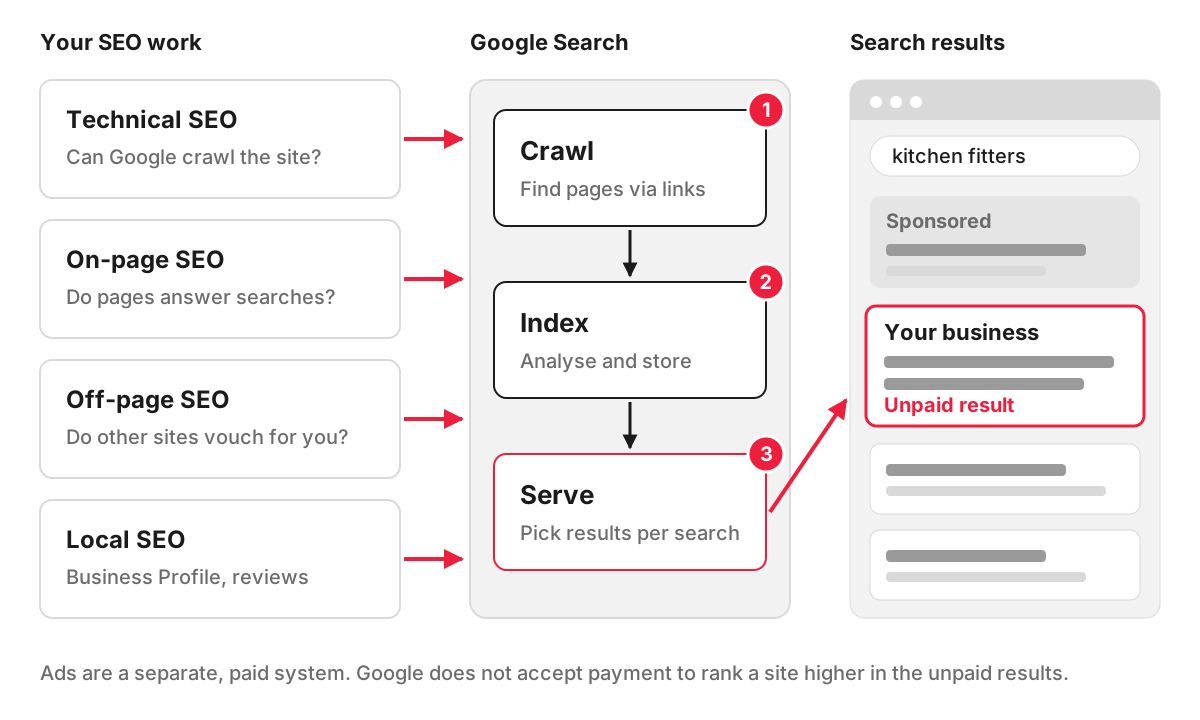
Google works in three stages, set out in its guide to how Search works. Crawlers find pages, mostly by following links. Each page is analysed and stored in the index. When someone searches, Google picks the results it judges most relevant for that query, place and device. A page that never reaches the index cannot rank for anything, which is why indexing is the first thing to check when a page is missing from search.
The unpaid results cannot be bought: the same guide states that Google does not accept payment to crawl a site more often or to rank it higher. The ads above and below them are a separate system, pay-per-click advertising, where you pay for every visit.
The four areas of SEO work
Most SEO work falls into four areas, and a site needs all of them in reasonable shape:
- Technical SEO. Search engines can crawl the whole site, pages load quickly on a phone, each piece of content has one address and nothing important is blocked. Duplicate addresses are handled through canonicalization.
- On-page SEO. Each page answers a real search, through its content, headings, title, description, images and links. Our entry on on-page SEO covers it element by element.
- Off-page SEO. What happens on other websites: links, mentions, reviews and press coverage that show other people vouch for you. See off-page SEO.
- Local SEO. For businesses that serve an area, the Google Business Profile and the map results. Google says local ranking depends on relevance, distance and prominence, and that prominence draws on how many websites link to the business and how many reviews it has.
What SEO looks like for a real business
Take an independent kitchen fitter that gets most of its work through referrals. Its potential customers search for things like “kitchen fitters near me”, “how much does a new kitchen cost” and “handleless kitchen ideas”. The current website has a home page, a gallery and a contact form, so nothing on it answers those searches.
An SEO plan for this business starts with keyword research to see which searches have real demand. Then come a page for each type of kitchen it fits, a price guide that answers the cost question honestly, project pages with photos and the town named, a clear title and description for every page, and a complete Google Business Profile that collects reviews after each job. Over time, mentions from the local trade association and the suppliers whose worktops it fits add the outside signals.
None of these steps is a trick. Each one makes it easier for Google to match the business to a search, and easier for the person searching to pick it.
SEO or paid ads?
Paid ads put you at the top of the page the day a campaign starts and disappear the day you stop paying. SEO takes months to build, and the visits it brings carry on without a cost per click. Many businesses run ads for enquiries now while SEO grows, then move budget as organic traffic picks up. Our article on contextual advertising or SEO compares the two in more detail.
How long SEO takes
Google’s starter guide notes that some changes take effect within hours and others take several months. A better title on a page that already ranks can show results within weeks; a new site competing for busy searches needs months. On our projects we plan for the first movement after two to three months, steady growth in months four to six, and the strongest results between six and eighteen months.
Choosing someone to do your SEO
Google publishes its own advice on hiring an SEO. Three points from it are worth keeping in mind:
- No one can guarantee a first place on Google. A provider who promises one is a reason to look elsewhere.
- Be wary of agencies that email you out of the blue, or that will not explain clearly what they plan to do.
- You should never have to link to your SEO provider from your own website.
Useful questions to ask any provider: which searches the work targets and why, how progress will be reported, and what you keep if you stop working together.
How we work on SEO
Our SEO services are paid monthly, with packages from £500 a month for local and small business SEO. Your plan is set for a year, with a review of results every six months, and you can cancel without penalty on 30 days’ notice. The first consultation is free and takes 30 minutes, so you can ask about your own site before committing to anything.
FAQ
Can you do SEO by yourself?
Yes, especially on a small site. Connect Google Search Console, give each page a clear title and description, write pages that answer your customers’ questions and keep your Google Business Profile complete. Our WordPress SEO guide for beginners walks through the basics. Specialist help pays off when the market is competitive, the site is large or technical problems are holding it back.
How do I know if my SEO is working?
Look at Google Search Console first: impressions, clicks and average position for the searches you target should rise over the months. Then check in your analytics whether visitors from organic search send enquiries or buy. Rankings alone can mislead, so judge the work by website visibility and by the enquiries it brings.
Does SEO still matter now that Google shows AI answers?
Yes. Google says there are no additional requirements for appearing in AI Overviews or AI Mode beyond the usual SEO basics. A page has to be indexed and eligible to appear with a snippet before Google can use it as a supporting link, so the work that helps a page rank also makes it a candidate for AI answers.
What is the difference between SEO and SEM?
SEM, search engine marketing, is the wider term. It usually refers to paid search advertising, and some people use it for paid and unpaid search together. SEO covers only the unpaid results.