
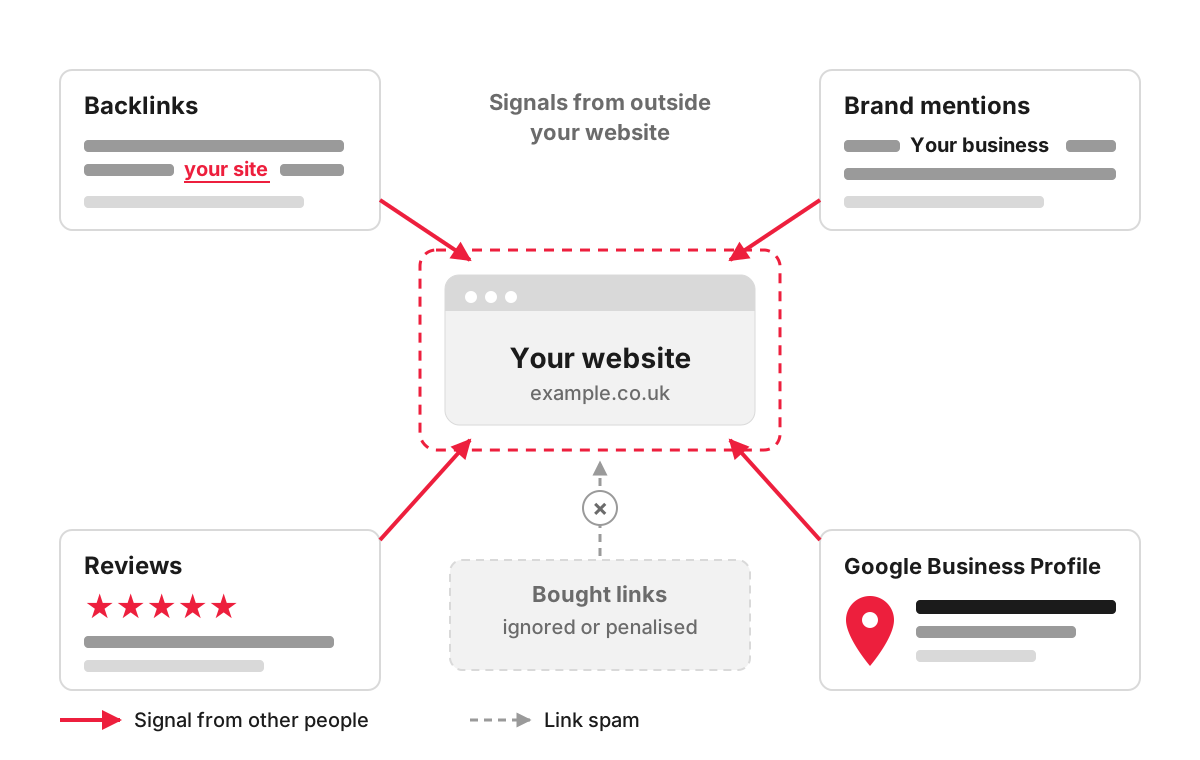
Off-page SEO is everything that happens outside your own website and affects how search engines rank it: mainly links from other sites, and also mentions of your business, reviews and press coverage. These signals show search engines that other people know the business and are willing to point their readers to it. It is also called off-site SEO, and some translated SEO texts call it “external optimisation”.
It sits alongside on-page SEO, which covers your own pages, and technical SEO, which covers the site as a whole. Good off-page signals help a relevant page compete; they do little for a page that does not answer the search in the first place.
Why links from other sites matter
Google says it uses links as a signal when determining the relevancy of pages and to find new pages to crawl. A link from a respected website in your field works like a recommendation: the other site’s editor chose to send readers to you.
Not every link counts the same. A mention in the regional newspaper, a listing by the trade body you belong to or an article on a well-read blog in your sector is the kind of link a real audience produces. A hundred links from unrelated directories is not, and Google lists low-quality directory links among its examples of link spam. All the links pointing to a site together make up its backlink profile, and reading that profile is the usual starting point for off-page work.
What off-page SEO includes
- Earned links and digital PR. Useful guides, original data, tools or newsworthy stories that journalists and bloggers want to cite. This is where off-page SEO overlaps with content marketing.
- Guest articles. Articles written for another site’s readers, with a link back where it helps them. Contacting editors to arrange these is called outreach.
- Brand mentions. Articles and lists that name your business, with or without a link. A mention without a link can often be turned into one by asking the author.
- Reviews and local listings. For local businesses, Google says that more reviews and positive ratings can help local ranking, alongside how many websites link to the business.
- Social media and influencers. Posts and creator content put your work in front of people who may later link to it or search for you by name. See social media marketing and influencer marketing.
An example from a wedding caterer
A wedding caterer has a good website and almost no presence anywhere else. Its off-page plan uses what the business already does. The venues it works with regularly are asked whether they list recommended suppliers, and several add it. Couples are sent a review request a week after the wedding. A wedding blog runs a real-wedding feature with photos from one event and credits the caterer. The local magazine publishes its seasonal menu as a short article.
Each of these links and mentions exists because readers find it useful. Together they tell Google, and the next couple searching, that this caterer is known in its area.
What Google treats as link spam
Google’s spam policies define link spam as links created mainly to manipulate rankings. The examples it lists include buying or selling links that pass ranking credit, excessive link exchanges, automated programs that create links, and guest posts or press releases stuffed with keyword-rich anchor text. Paid placements are allowed when the link is marked with rel=”sponsored” or rel=”nofollow”.
Links like these can be ignored by Google or lead to a manual action against the site, so money spent on them can be lost twice: once on the links and again on cleaning them up.
How to measure off-page SEO
- The Links report in Search Console shows which sites link to you most, which pages they link to and the most common link text. It is a sample, but it comes from Google.
- SEO tools such as Ahrefs and Semrush crawl the web themselves and show new and lost links over time, as well as competitors’ links for comparison.
- Searches for your brand name in the Search Console Performance report tend to grow as more people hear about you elsewhere.
- Your enquiries. Asking new customers where they heard of you catches the press coverage and recommendations that no tool records.
How we work on off-page SEO
Our link building is built on publications on relevant sites. Trust and outreach publications start from £95 per publication, and every paid publication is marked as sponsored, as Google requires.
FAQ
What are the two types of SEO?
People usually mean on-page and off-page SEO: what you do on your own pages and what happens on other websites. Many specialists split technical SEO out as a third type, covering crawling, speed, mobile display and site structure. All three affect the same rankings, so they are planned together.
Can a website rank without backlinks?
For searches with little competition, often yes: a local business with a relevant page and a complete Google Business Profile can appear for its own town and services with very few links. For competitive searches, pages without links from other sites struggle against pages that have them.
How long does off-page SEO take to work?
A new link counts only once Google has found and indexed the page it sits on, which can take days or weeks. After that, the effect builds gradually as more links and mentions accumulate. Off-page work is usually judged over months, not from one link to the next.
Can I do off-page SEO myself?
Much of it, yes. Ask the suppliers, associations and partners you already work with whether they list or feature businesses like yours, ask happy customers for reviews, and offer local press a story or expert comment when you have something genuinely new. What takes specialist time is finding enough relevant publications and checking that every link is placed in a way Google accepts.