A backlink profile is the full set of links pointing to a website from other websites, together with what describes them: which sites they come from, which pages they point to, the words they use and how they came about. SEO specialists read it to judge how much trust a site has earned from the rest of the web, and whether any of its links carry risk. Some translated SEO texts call this “link mass”, meaning the total of a site’s incoming links; in English the usual terms are backlink profile or link profile.
Links from other sites are the main part of off-page SEO, so the profile is where any decision about building new links starts.
What a backlink profile is made of
- Referring domains and backlinks. A site that links to you from its footer on 300 pages gives you 300 backlinks but only one referring domain. The number of different sites linking to you usually says more than the raw link count.
- Relevance and quality of the linking sites. A link from a trade publication your customers read means more than one from a site with no audience or no connection to your field.
- Anchor text. The clickable words of each link. A natural profile is dominated by your business name, your web address and ordinary phrases; see anchor text for the types.
- Target pages. Links spread across the home page, service pages and useful articles look like real recommendations. Hundreds of links to one sales page do not.
- Link attributes. Links marked rel=”nofollow”, rel=”sponsored” or rel=”ugc” tell Google how the link came about. Google asks for paid placements to be marked as sponsored, and for links in comments and forum posts to be marked as ugc.
- Growth over time. Steady growth that follows the business’s real activity, such as press coverage or a popular guide, looks different from hundreds of links appearing in one month.
Reading a profile: an example
An independent veterinary practice has links from about forty websites. When a specialist sorts them, three groups appear:
- The real profile. The local community news site, a pet charity the practice supports, two veterinary associations, a few suppliers and the council’s business directory. These are relevant, varied and clearly earned.
- Filler. Around fifteen general web directories with no visitors. They do little harm and little good.
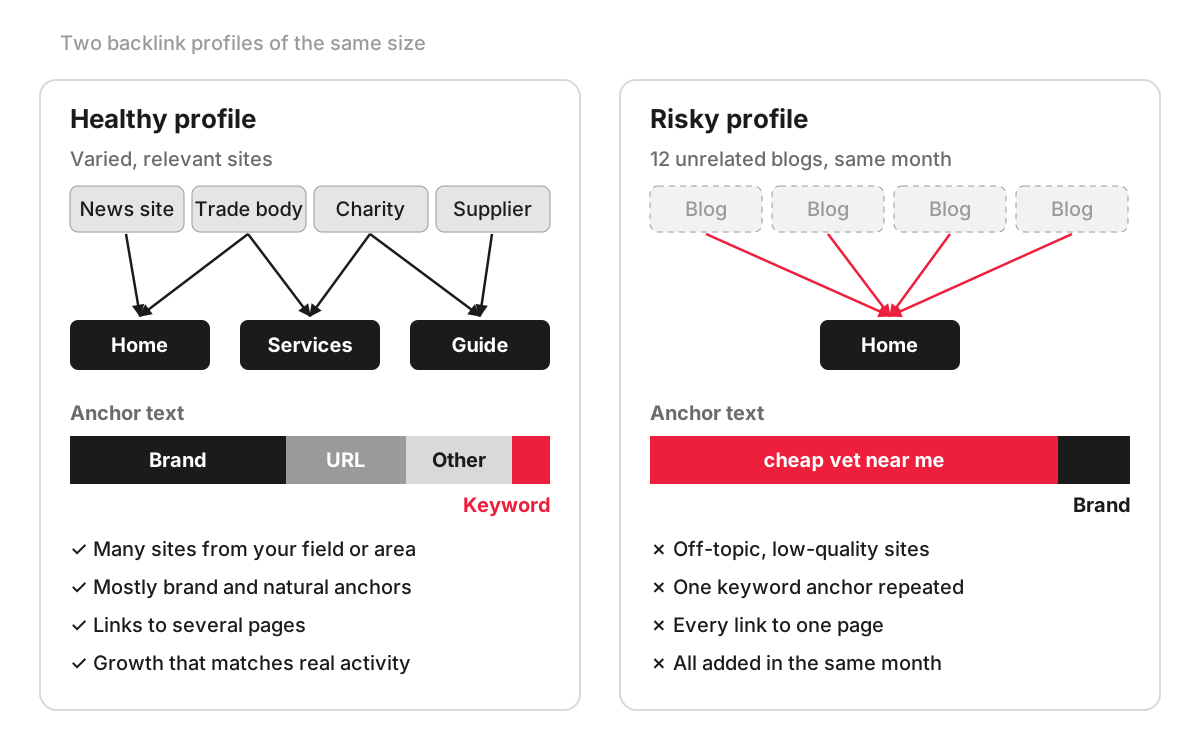
- A warning sign. A dozen links from unrelated foreign blogs, all added in the same month, all using the words “cheap vet near me” and all pointing to the home page. The pattern looks like links that were bought or arranged at some point, and it needs investigating before any new link building or outreach starts.
The practice does not have a bad profile. It has a good core, some noise and one problem that is worth understanding.
Signs of a healthy and a risky profile
A healthy profile usually has links from sites in your field or your area, mostly branded or natural anchors, links to several different pages and growth that matches what the business actually does.
Risk shows up as patterns: many links from unrelated or low-quality sites, the same keyword-rich anchor repeated across many sites, the same link in the footer of every page of another site, link exchanges or partner pages that exist only to swap links, and paid links that are not marked as sponsored. Google’s spam policies list most of these as examples of link spam, including widely distributed footer links and low-quality directory links.
How to check your backlink profile
- Google Search Console. The Links report shows your most linked pages, the sites that link to you most and the most common linking text. Google describes it as a sample of links, not a complete list, but it is the only view that comes from Google itself.
- SEO tools. Ahrefs, Semrush and similar tools crawl the web independently and show each link with its anchor, its first-seen date and the strength of the linking site. Their scores, such as domain rating, are the tool’s own estimates and not figures Google uses.
- Competitors. Comparing your referring domains with those of the sites that rank above you shows the size of the gap and where their links come from.
Do you need to disavow bad links?
Usually not. Google’s disavow tool lets you ask Google to ignore specific links, but its help page says to use it only if you have a considerable number of spammy, artificial or low-quality links and they have caused, or are likely to cause, a manual action. It calls disavowing an advanced feature to be used with caution. If you have no manual action and did not buy or arrange the links yourself, a few odd links in the profile are rarely a reason to act.
How we work with backlink profiles
Before planning new links, our link building starts with an analysis of your site and of the link profiles of competitors in your field. Paid publications are marked as sponsored, as Google requires. We check that each new link is indexed two to four weeks after publication, and the monthly report shows every link, the month’s budget and what was spent, so you can see how the profile changes over time.
FAQ
What is an example of a backlink?
If a local newspaper publishes an article about your new shop and links the words “Riverside Bakery” to your website, that is a backlink. In the newspaper’s code it is a standard link element, such as <a href="https://www.example.co.uk/">Riverside Bakery</a>. The newspaper is the referring domain, the article is the linking page and “Riverside Bakery” is the anchor text.
How many backlinks does a website need?
There is no fixed number. What matters is how your profile compares with the pages that already rank for your searches. The pages ranking for a local search usually have links from far fewer sites than those ranking for a national one, so the target is set by the competition you actually face.
Are backlinks still important for SEO?
Yes. Google’s guide to its ranking systems says that PageRank, one of the core systems it launched with, continues to be part of its core ranking systems, alongside other systems that look at how pages link to each other. What has changed over the years is how well Google recognises links that were arranged purely for ranking.
What is a toxic backlink?
“Toxic” is a label used by some SEO tools for links they score as risky. It is not a term Google uses, and the scores are estimates. The useful question is whether a link matches one of the patterns in Google’s spam policies, and whether you or someone working for you arranged it.