
A website brief is a short document in which a business explains to a web agency what its new or redesigned site is for: the goals, the audience, the pages and features it needs, the content available, the budget and the deadline. It gives the agency enough to ask the right questions and prepare a realistic quote.
What a good website brief includes
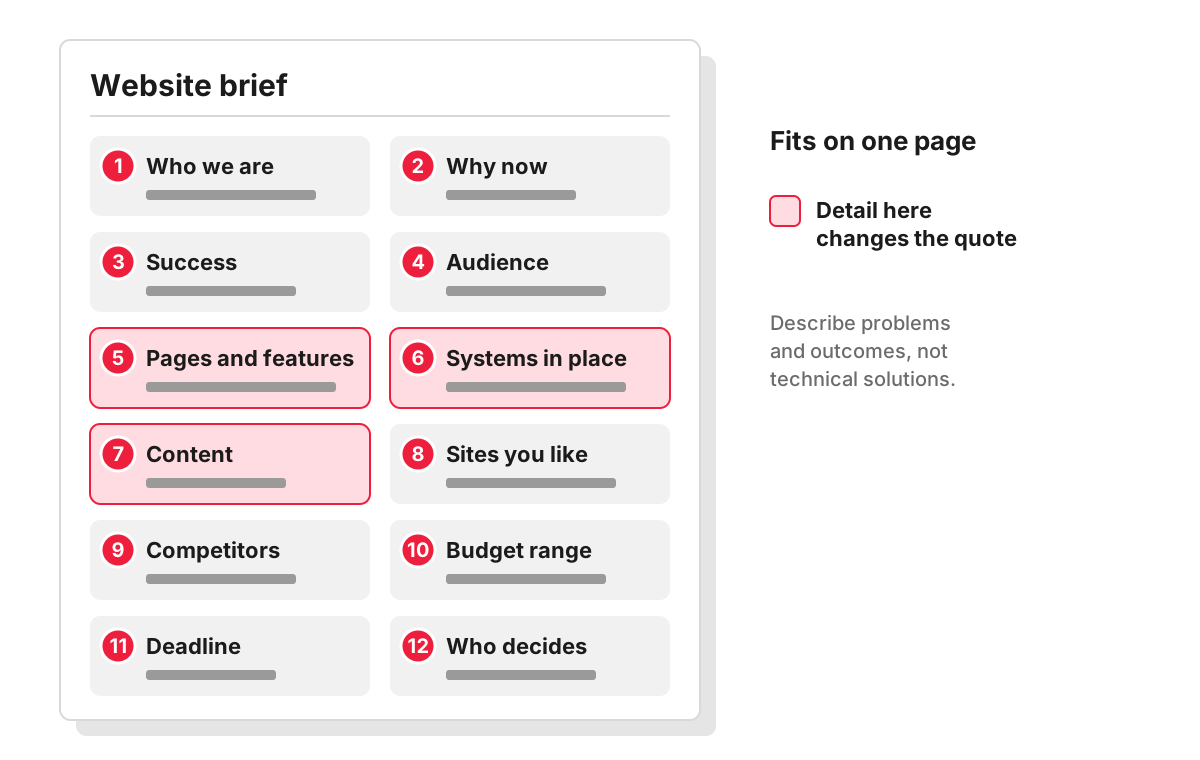
Picture a dental clinic in Oxford that wants patients to book appointments online. Its brief would answer these questions, in the clinic’s own words:
- Who you are. A paragraph about the business, its services and what makes it different.
- Why now. What is wrong with the current site, or what has changed: a new service, a new location, too many phone calls for simple bookings.
- What success looks like. The outcome you will measure, such as more online bookings, more enquiries for implants, fewer calls about opening hours.
- Who the site is for. New patients, existing patients, referring dentists, job applicants.
- Pages and features. The pages you expect and the functions that matter: online booking, a price list, finance information, a team page.
- Systems already in place. The booking or practice management software, the CRM, the email platform, the domain and hosting, so the agency can check what the site must connect to.
- Content. What you already have (texts, photos, videos, reviews), what needs writing, and who will write it.
- Sites you like and dislike. Two or three examples each, with a line on why.
- Competitors. The practices patients compare you with.
- Budget. A range is enough. It tells the agency which options are worth proposing.
- Deadline. The date, and the reason for it if there is one, such as a new branch opening.
- Who decides. The person who approves designs and signs off the work.
How much detail an agency needs
Describe problems and outcomes in plain business language and leave the technical solution to the agency. “Patients should be able to book a hygienist appointment from their phone in under a minute” is more useful than “add a booking plugin”.
Add detail wherever it changes the cost. The number of products, the languages, customer accounts, payments and every system the site must exchange data with all move the estimate significantly. Colour preferences and the exact wording of the menu can wait.
It also helps to mark what is fixed and what is flexible. If the launch date cannot move but the blog can come later, say so: the agency can then propose a first release that fits the date.
When you cannot answer every question
Gaps are normal, and a brief with honest unknowns gets better answers than one filled with guesses. Write what you do know and flag the rest: “about 300 products, not sure yet whether stock should sync with the warehouse”, or “budget not set, we would like to see options”.
A good agency turns those gaps into questions on the first call. Some answers come from your team, some from your current analytics or software supplier, and some are decisions the agency can help you make with the pros and cons laid out.
Example of a filled-in website brief
Here is a short brief for a fictional family-run bakery with two shops, which wants to take celebration cake orders online. It is an illustration, not a real client:
- Who we are. A family bakery with two shops, best known for birthday and wedding cakes made to order.
- Why now. Cake orders arrive by phone and Instagram messages, and details such as flavour and collection time get lost.
- Success. Most cake orders placed on the website, with a deposit paid online.
- Audience. Local families planning birthdays and weddings, and offices ordering for events.
- Pages and features. Home, cake gallery, order form with sizes and flavours, collection and delivery, about, contact.
- Existing systems. A card payment provider used in the shops; the domain is registered, nothing else is connected.
- Content. Photos of past cakes; no website copy yet, the owner will review drafts.
- Sites we like. A local florist’s site, because ordering takes one page.
- Budget. A range agreed between the two partners; online deposits are the must-have, the gallery can stay simple.
- Deadline. Live before spring, when wedding enquiries start.
- Who decides. The owner approves designs; her business partner signs off the budget.
That fits on one page, and an agency can already see the main cost drivers: a custom order form, online payments and the content still to be written.
What happens after you send it
The agency reads the brief, comes back with questions and usually arranges a call. Then it either sends a proposal with a price range or suggests a short discovery phase to pin down the details first.
When you start a website design project with us, the next step after the brief is a short Discovery stage, after which we confirm the final price and send a line-item estimate. The pages, features and priorities from your brief then become wireframes and clickable prototypes, which we make in Figma.
Common mistakes in website briefs
- Describing the business and forgetting the customer. A page of company history says little about what customers ask before they buy. The questions your staff answer every week are worth more to the agency.
- Leaving out brand assets. Logo files, brand guidelines, licensed fonts and photo rights all shape the design. If they turn up after the first concepts, part of the design work is done twice.
- Treating content as a last step. Texts, photos and product data often take longer to prepare than the design itself, and a site cannot launch with empty pages. Plan it alongside the design, with its own dates.
- Forgetting life after launch. Who will update prices and news, who looks after hosting, updates and backups, and what support you expect from the agency. These answers change both the choice of CMS and the quote.
Website brief vs technical specification
The two documents are often confused because both describe the future site. They do different jobs and come at different moments:
- Who writes it. You write the brief. The technical specification is usually written with the agency, with you reviewing and signing it off.
- What it answers. A brief explains why the site is needed and what it should achieve. A specification describes how each page, function and integration will work.
- Level of detail. A brief can fit on a few pages. A specification covers every feature, down to form fields, user roles and acceptance tests.
- What it is used for. A brief starts the conversation and gets you an initial quote. A specification is the document the site is built and tested against, and the basis for a precise estimate.
- When it appears. The brief comes first. The specification grows out of it during discovery.
You do not need to write a specification to approach an agency. A clear web design brief is enough to start, and the specification can be developed together once the project is under way.
FAQ
What is the difference between a website brief and a design brief?
A website brief covers the whole project: goals, pages, features, systems, content, budget and deadline. A design brief is narrower and deals with the look: brand, tone, the feelings the design should create and examples of styles you like. For a website, the design brief usually sits inside the website brief as one section. A creative brief is a different document again, used to plan an advertising campaign.
What should a brief for a website redesign include?
Everything in a new-site brief, plus what the current site already does well. List the pages that bring in most visitors and enquiries, the forms and integrations that must keep working, and any email accounts on the same domain. With that list, the agency can plan the migration so the new site keeps the search traffic the old one earned. If organic search matters to you, our guide to building a website with SEO in mind covers what to plan before the build.
Can an agency write the brief for you?
An agency can help you put it together, usually with a questionnaire or a structured call, and then write up what it heard for you to check. What it cannot do is supply the business answers: your goals, your customers, your budget and who decides. Those still come from you, even if someone else types them up.
Should you send the same brief to several agencies?
Yes, if you want to compare their proposals. When every agency answers the same brief, differences in price and approach reflect the agencies themselves. Share any extra answers you give one agency with the others as well, so the comparison stays fair.