
A domain, or domain name, is the address people type to reach a website, such as yourbusiness.co.uk. It is a readable name that stands in for the numeric IP address of the server where the site is stored, and the same name usually carries the business’s email addresses too.
How a domain works
Computers find each other by IP addresses, strings of numbers that people cannot remember and that change when a site moves to another server. The Domain Name System (DNS) acts as the internet’s phone book: when someone types your domain, their browser asks a DNS server which IP address it points to, then requests the site from that server. MDN’s guide to domain names walks through the lookup step by step.
You control where the domain points through its DNS records, which are set at your registrar or DNS provider. Two matter most to a business:
- A records (and their IPv6 version, AAAA) send visitors to the server that runs your website.
- MX records send email for @yourbusiness.co.uk to your email provider.
Because the two are separate, a bakery can keep its website with one hosting company and its email with Microsoft 365 or Google Workspace, all under one domain. Moving the website then means changing the A record, and the email carries on untouched.
Domain, hosting and website: how they differ
Think of a shop. The domain is the street address on the sign, the hosting is the premises, and the website is everything inside: pages, photos, products and forms, usually managed in a CMS. You need all three, and you can change any one of them without giving up the others. A business can move to new premises (hosting) and keep its address (domain), or refit the inside (redesign the website) without moving at all.
The parts of a domain name
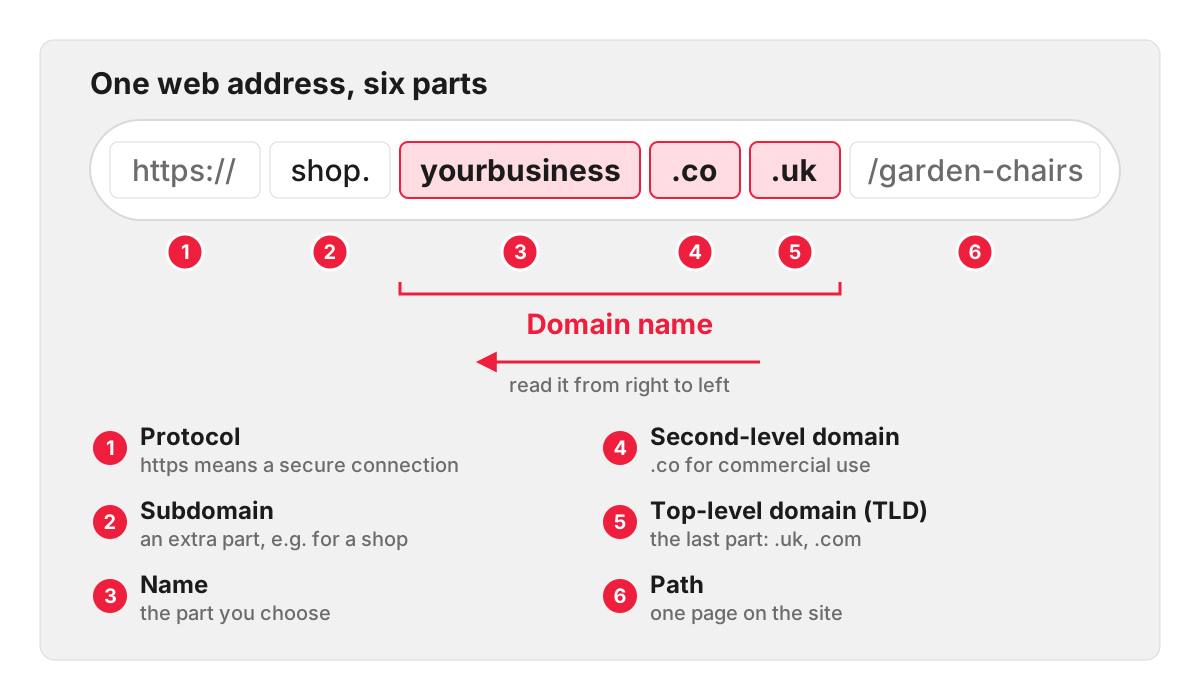
Domain names are read from right to left:
- Top-level domain (TLD): the last part, such as .uk, .com or .org.
- Second-level domain: in the UK this can be a category, as in .co.uk or .org.uk.
- Name: the part you choose, such as yourbusiness.
- Subdomain: anything you add in front, such as shop.yourbusiness.co.uk or book.yourbusiness.co.uk, often used for an online shop or booking system that runs on a different platform.
How .uk domains work
Domains ending in .uk, including .co.uk, are run by Nominet, the .uk registry. You do not buy from Nominet directly: you choose a registrar (a domain company or your web host), and under Nominet’s registrant terms and conditions the registrar acts on your behalf and instructs Nominet to create the domain.
The main options for a business, as set out in Nominet’s registration policy:
- .co.uk is intended for commercial use. The rule is advisory only.
- .uk is the shorter version, intended for anyone who wants to be associated with the United Kingdom.
- .org.uk is intended for charities, community groups and other not-for-profit or public service bodies.
- .ltd.uk and .plc.uk are restricted to companies registered at Companies House, and the domain has to match the registered company name.
- .me.uk is only for individuals.
A few rules in the registrant terms are worth knowing. A .uk domain is registered for between one and ten years and can be renewed before the term ends; if it is not renewed, the registrar asks for it to be deleted. The registrant must keep contact details accurate and update them within seven days of a change, and giving wilfully inaccurate details is grounds for Nominet to cancel the domain or restrict its use.
Why your domain matters to the business
Your domain appears on your van, your invoices, your email signature and in every search result, so changing it later is expensive. It also counts for search: Google’s guidance on managing sites for different countries says a country-code domain such as .uk sends a strong signal to users and search engines that a site is intended for that country. For a business that only serves UK customers, a .co.uk or .uk name does this job without extra setup. A .com can still target the UK, using the other signals Google describes on the same page.
Changing domains is possible, as a website migration with redirects from every old address, but your existing SEO has to be carried across with care.
Keeping your domain safe
Strictly speaking, you rent a domain for a period. As the MDN guide puts it, you never own the name, but your right to renew it comes first. What you control is who is recorded as the registrant. Domain problems usually come from a few avoidable gaps:
- the domain was registered by a former employee, a designer or an agency in their own name;
- the renewal reminders go to an email address nobody reads, and the card on file has expired;
- nobody knows the login for the registrar account.
Register the domain in your business’s name, keep the registrar account under a shared company email, switch on auto-renew and add a second card or a long renewal period. When we build a site, the same principle applies to everything around it: you own the code, content and accounts, and we provide documentation. If you are planning web development work, an audit of your domain, DNS and email setup is a sensible first step.
FAQ
Should I choose .uk or .co.uk?
If you sell mainly in the UK, either works, and both tell search engines your site is meant for UK users. .co.uk is the older and more familiar ending for British businesses, while .uk is shorter. Many businesses register both, use one as the main address and redirect the other to it, so customers who type the wrong one still arrive.
How much does a domain name cost?
A domain is a yearly fee, and the price depends on the ending and the registrar. Compare the renewal price as well as the first-year offer, because introductory prices are often lower. Extras such as email hosting are usually charged separately. Our guide on how to buy a website name covers the buying process.
Can I have more than one domain for one website?
Yes. Many businesses hold common misspellings, a .uk and a .co.uk, or a name for a campaign. Pick one main domain for the website and set the others to redirect to it permanently, so search engines see a single address and your visitors always land in the same place.
How do I choose a good domain name?
Keep it short, easy to spell when heard over the phone, and close to your business name. Avoid hyphens and numbers unless they are part of your brand, and check that no one else trades under the same name. Our article on choosing the right domain name goes through the options in more detail.