
Backend development is the work on the server side of a website or web application: the database that stores information, the code that applies the business rules, the admin area where staff manage content and orders, and the connections to outside systems such as payment providers or a CRM. Visitors never see the backend, but almost everything they do on a site depends on it.
What the backend does on a business website
Picture an online shop selling made-to-measure blinds. A customer enters the window size, picks a fabric, adds a postcode and pays. On screen it looks like a few clicks. Behind it, the backend is doing most of the work:
- Storing data. Products, prices, fabric options, stock levels, customer accounts and orders all live in a database, and the backend reads and writes them.
- Applying business rules. It works out the price for those measurements and the delivery charge for that postcode, checks the fabric is in stock, applies a discount code and decides whether the order qualifies for free delivery.
- Running the admin area. Staff log in to add products, change prices, answer enquiries and mark orders as dispatched. That screen is part of the backend.
- Talking to other systems. The payment provider confirms the payment, the order is passed to the warehouse or accounting software, and the customer’s details go into the CRM. These connections usually run through an API, a set of rules for how two systems exchange data.
- Keeping things secure. Logins, passwords, permissions and personal data are handled on the server, where visitors cannot tamper with them.
A simpler site has a smaller backend. On a brochure site for a joinery firm it may be little more than a content editor and a contact form that emails the office. A booking system for a clinic, with practitioners’ calendars, reminders and deposits, needs far more.
Backend and frontend: how they split the work
The frontend is everything that runs in the visitor’s browser: the layout, the text and images, the menus, the animations, the form fields. It is built with HTML, CSS and JavaScript.
The backend runs on the server. When the visitor submits the form, the frontend sends the data, and the backend checks it, stores it, sends the confirmation email and passes the lead to the CRM.
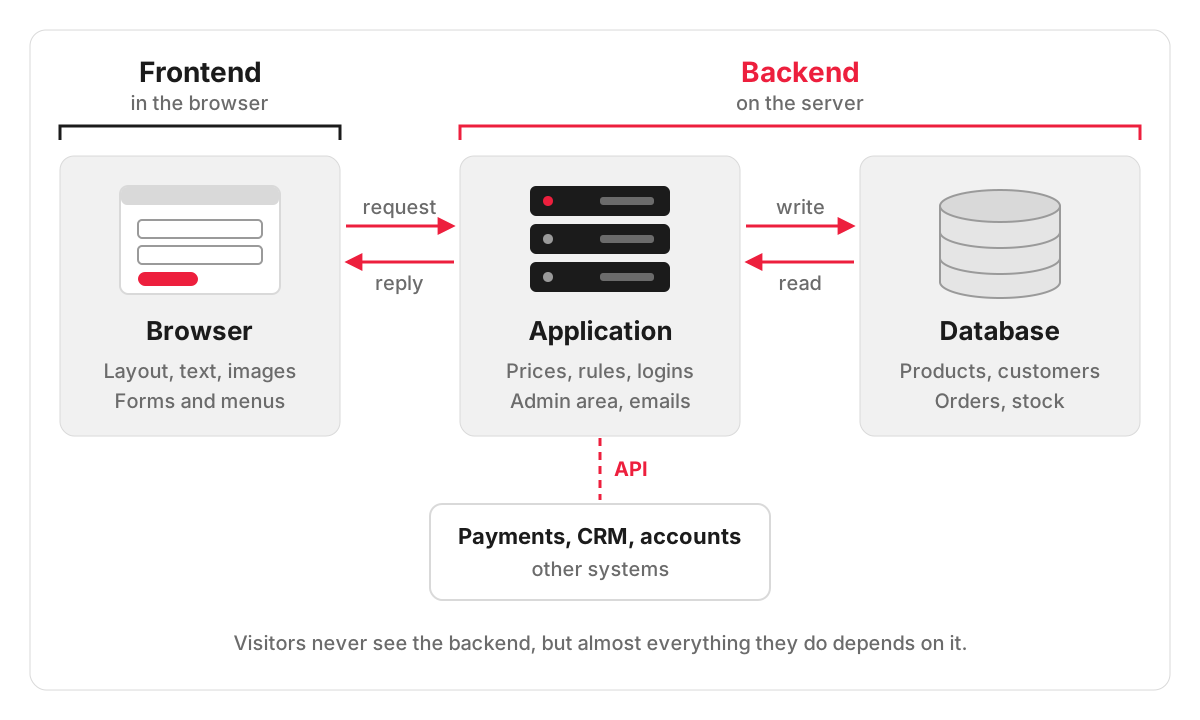
On the blinds shop, the product page with its gallery, fabric swatches and size fields is frontend, and everything in the list above is backend. A developer who works on both is called full-stack. On a modern site the two often talk to each other through a REST API, which also lets the same backend serve a website and a mobile app.
A CMS or a custom backend?
For many business websites a ready-made content management system is enough. WordPress or Shopify already includes a backend: an admin area, a database, user accounts, and a large range of plugins and apps for forms, bookings and payments. The page on content management systems covers how to choose one.
A custom backend starts to make sense when the business logic is your own and no plugin fits it well. Typical signs:
- Pricing depends on rules specific to your business, such as trade prices per customer, quotes built from measurements, or delivery charges by zone and product size.
- Customers or partners need their own accounts with documents, orders, bookings or progress they can track.
- The site has to exchange data with internal systems in both directions, for example stock from a warehouse system and orders back to accounts.
- Several plugins have been stacked to imitate one workflow, and updates keep breaking it.
- Several websites need to be run from one admin area.
There is a middle ground too. A CMS can be extended with custom modules or connected to other systems, and that is often the right first step when only one or two features are unusual.
Which technologies are used for backend development
- PHP is one of the most established backend languages and the one WordPress runs on. Laravel is a PHP framework for custom web applications. Its documentation describes it as a backend framework with routing, validation, caching, queues and file storage built in.
- JavaScript and TypeScript on Node.js, often with frameworks such as Express or NestJS, let one language run both in the browser and on the server.
- Python, usually with Django or Flask, is common where a project leans on data processing or machine learning.
- Ruby on Rails, Java and C# with .NET are also common, the last two especially in larger corporate systems.
- Databases such as MySQL and PostgreSQL store the data whichever language is used.
For a business, the choice of language matters less than whether developers for it are easy to find, whether it suits the project’s size, and whether the code is documented well enough for another team to take over.
Custom backends on Laravel
We build custom websites and web applications on Laravel, and where a project calls for it we integrate AI into the application itself.
On Laravel development projects, the final price is confirmed after a short Discovery stage and set out in a line-item estimate. The code, content and accounts are yours, and we provide documentation.
FAQ
Is backend development the same as web hosting?
No. Hosting is the server the site runs on. Backend development is the code that runs on that server. Good backend code still needs suitable hosting, and a fast server cannot make up for slow code.
Can the backend be changed later without rebuilding the whole site?
Often, yes. A well-structured backend can gain new features, integrations or an API while the design stays as it is. Replacing the backend completely, for example moving from a CMS to a custom application, is a bigger step: content, user accounts and URLs all move, so it is planned like a website migration.
What skills does a backend developer need?
For a business project, the useful set is one backend language and its framework in depth (PHP with Laravel, for example), database design, building and connecting APIs, and security: logins, permissions and the handling of personal data. Testing matters as much as writing code. When you compare developers or agencies, ask how they test changes before they go live and how they handle updates to the framework.
Is Laravel used for the backend or the frontend?
Laravel is a backend framework, but it can also produce the pages visitors see. Its frontend documentation describes three routes: Blade templates rendered on the server, Livewire for dynamic pages written in PHP, and Inertia for a React, Svelte or Vue frontend that shares Laravel’s routes and authentication.
How much does backend development cost?
It depends on the business rules, the number of integrations and how many types of user accounts the site needs. A site on WordPress or Shopify uses the backend that comes with the platform, so custom backend work is limited to the features it does not cover.