E-commerce (electronic commerce, also written ecommerce) is the buying and selling of goods or services online, with the order, and usually the payment, completed over the internet. For a business, it means selling through an online shop on its own website, through marketplaces such as Amazon, eBay or Etsy, or through both.
It is a large part of how the UK shops. In September 2026, online sales made up 28.8% of all retail sales in Great Britain, according to the Office for National Statistics’ retail sales bulletin. E-commerce also goes beyond retail: booking a course and paying a deposit, ordering trade supplies on account or subscribing to a monthly delivery are all forms of it.
How an online sale works
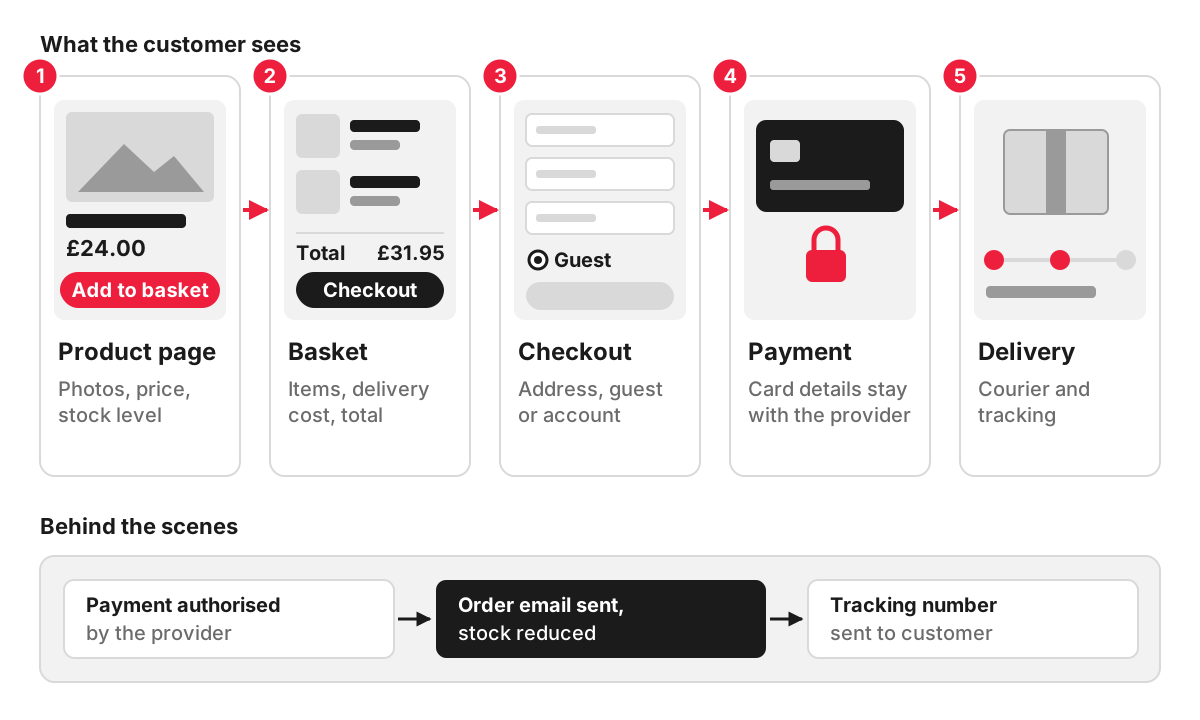
From the customer’s side, an online purchase takes a few clicks. Behind it, several systems work together:
- Product page. Photos, description, price, stock level, delivery options.
- Basket and checkout. The customer enters a delivery address, chooses delivery, and checks out as a guest or with an account.
- Payment. A payment provider such as Stripe, PayPal or a bank’s card service checks and authorises the payment. The shop never needs to store card details itself.
- Confirmation. The customer receives an order email; the shop’s admin panel shows the new order and reduces the stock.
- Fulfilment. The order is packed and passed to a courier, and the tracking number goes to the customer.
- After the sale. Returns, refunds, reviews and, often, the next order.
Larger shops also connect the site to accounting software, a warehouse or stock system, courier accounts and a CRM, so orders do not have to be re-typed between systems.
Types of e-commerce
E-commerce is usually grouped by who sells to whom:
- B2C (business to consumer). A shop selling to the public, such as a garden centre selling plants online.
- B2B (business to business). Trade sales, often with customer-specific price lists, minimum order quantities and payment on invoice.
- C2C (consumer to consumer). Individuals selling to each other through platforms such as eBay or Vinted.
- C2B (consumer to business). Individuals selling to businesses, such as freelancers or photographers licensing their work.
You will also see D2C (direct to consumer), where a manufacturer sells directly to customers without retailers in between, and models defined by what is sold: physical products, digital downloads, subscriptions, or services and bookings.
Your own online shop or a marketplace?
Marketplaces bring ready-made traffic and trust: people already shop there. In return, you pay fees on each sale, follow the marketplace’s rules, compete next to similar products on the same page, and the customer relationship largely belongs to the marketplace.
Your own shop gives you control over the brand, prices, product range and customer data, and no commission on each sale beyond payment fees. The trade-off is that you have to bring the visitors yourself, through search engine optimisation, advertising, email and social media.
Many businesses use both: marketplaces for reach and discovery, their own site for repeat customers and full-range sales.
Common e-commerce platforms
An online shop runs on a content management system built or extended for selling:
- Shopify is a hosted platform paid by monthly subscription, with hosting, checkout and security handled for you. Our article on how Shopify works covers it in more detail.
- WooCommerce adds a shop to a WordPress site. You host it yourself and extend it with plugins.
- OpenCart is an open-source shop platform, also self-hosted.
- A custom build, for example on Laravel, suits B2B pricing rules, complex product configurations or heavy integrations that off-the-shelf platforms struggle with.
What UK online sellers must show customers
Selling online to consumers comes with specific legal duties. GOV.UK’s guide to online and distance selling lists what you must tell customers before they order, including your business name, contact details and address, a description of the goods or services, the price including all taxes, delivery arrangements and costs, and your cancellation terms. Customers can cancel an order up to 14 days after it is delivered, and if you do not tell them about this right, they can cancel at any time within the next 12 months. The same guide lists exemptions, such as goods and services worth £42 or less.
Data protection, cookies and VAT have rules of their own, so check them before launch. Treat this section as an overview; it is not legal advice.
What makes an online shop sell
- Product pages that answer questions: clear photos, sizes and dimensions, materials, delivery times, and the returns policy one click away.
- Delivery costs shown early, not revealed at the last step of checkout.
- A short checkout that works on a phone, with guest checkout and familiar payment options.
- Visible trust signals: reviews with their source, a real address and phone number, secure payment.
- Search and filters that let people narrow a large range quickly.
- Purchase tracking in analytics, so you know which channels and products bring revenue.
How we build online shops
We build online shops on Shopify, WordPress, OpenCart and Laravel. As a guide, our e-commerce and custom websites start from £12,500, and a large online shop takes around 4-8 months from start to launch. The final price is set after a short Discovery stage, with a line-item estimate. You own the code, content and accounts, and we provide documentation. More on our e-commerce website development page.
FAQ
How do you make money from e-commerce?
By selling for more than everything it costs to get the product to the customer. Beyond the product itself, that includes packaging and delivery, payment fees, platform or marketplace fees, returns, and the marketing cost of winning each order. A returning customer usually costs far less to win than a new one, so email and service after the sale matter as much as the first order.
What are the ongoing costs of running an online shop?
Expect a platform subscription or hosting, a domain, payment processing fees on each sale, paid apps or plugins, and regular updates and maintenance. On top come the costs of getting visitors, such as advertising and SEO, and the time spent on product photos, descriptions and customer service.
What is m-commerce?
M-commerce (mobile commerce) is e-commerce on a phone or tablet, through a mobile website or an app. In practice it is part of e-commerce, not a separate channel: an online shop has to work well on a phone, from the product page to the payment, because that is where many customers browse and buy.
Can I sell online without my own website?
Yes. You can start on a marketplace such as Etsy, eBay or Amazon, or sell through the shop features some social platforms offer. It is a quick way to test demand. Once sales grow, your own shop usually becomes worth it, for lower fees per sale, control over the brand and direct contact with your customers.